As I progressed through life, I became increasingly aware of two major constraints on productivity: time and energy. While energy depends on the health of both body and mind, today I’ll focus on time.
By the time you’re 10–20 years into your career, you (hopefully) have a solid grasp of managing your schedule. I recommend founders conduct regular time audits and energy audits of their weeks and months to ensure they’re dedicating resources to the things that truly matter and bring energy (their “zone of genius”).
Another way to approach this is by examining your operating rhythms—daily, weekly, monthly, quarterly, and yearly. While having a 3/5/10-year vision of who and where you want to be is essential, for operational purposes, let’s narrow the rhythm to a one-year cycle.
Annual Operating Rhythms
At the end of 2024, I listed activities that follow a regular cadence and categorize them into three groups:
- Must-do activities (e.g., sleep).
- Should-do activities that require prioritization. (e.g., mostly work related)
- Aspirational activities I’d like to incorporate into my life. (e.g., exercising more, write more, volunteering more, hosting certain events)
These “building blocks” sustain my work as a builder and investor while also reflecting areas where I want to evolve.
This list includes everything from sleeping, eating, and morning routines to executive meetings and annual health checkups. For each activity, I calculate priorities and the average hours spent multiplied by the number of sessions per year. Some goals are aspirational (e.g., sleeping 7 hours a night, compared to my current 4–5 hours) while others are based on historically observed patterns or pre-scheduled realities.
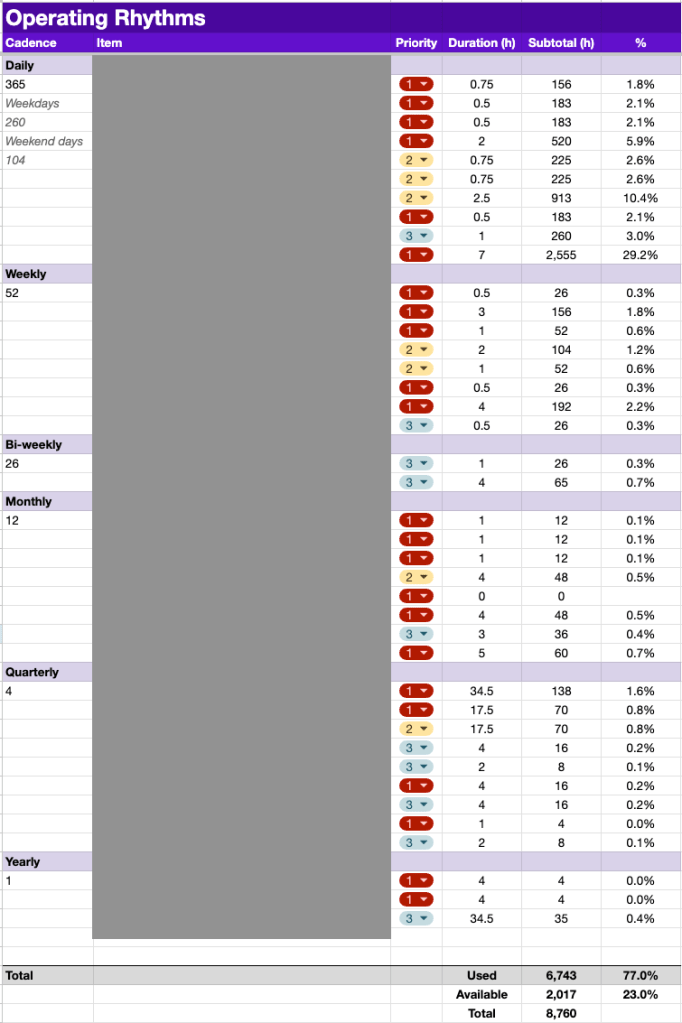
Foundational Blocks
Initially, these foundational blocks consumed over 80% of my life, leaving minimal time for “value-creative” work or other essential tasks (e.g., international travel to meet key customers). I had to streamline these blocks, and now I have approximately 2,000 hours annually to allocate toward building, selling, recruiting, supporting founders, or simply enjoying time with friends.
It’s worth noting that I have significant recurring commitments (e.g., company-related tasks, investor duties, YPO meetings, etc.), but I’m curious how your time allocation might compare.
Breaking Your Time Piggy Bank
Imagine this: every 30 minutes or hour you dedicate to a meeting, attending an event, or pursuing a hobby is deducted from this 2,000-hour time budget. Breaking this down further:
- Per quarter: 500 hours
- Per month: 166 hours
- Per day: ~5.5 hours
This budget includes all activities outside the foundational table, such as meetings in your office, driving to meet a friend, waiting in line for coffee, watching a short video, or even writing this blog post.
Thoughts from Time Budgeting Exercise
Completing this exercise helped me build intuition about how much time is spent just keeping my life running. It also highlighted the importance of qualifying, prioritizing where I allocate time budget, and then fully focusing on time blocks to to maximize the productivity or experience.
I’m curious how other entrepreneurs and investors approach time budgeting over the year. Let me know your thoughts! 🙂


Leave a Reply