The “Mad Genius” Paradox
History has long suggested a link between madness and genius. Modern neuroscience suggests that creative geniuses may indeed possess the “right amount” of crazy. The key predictor of high creative achievement appears to be a specific cognitive combination: Reduced Latent Inhibition (a difficulty in filtering out irrelevant stimuli) paired with High IQ.
In this model, High IQ acts as a transformative force, turning a potential cognitive deficit (psychosis/distractibility) into a creative advantage.
The Biological Architecture
To understand the “creative genius” phenomenon neurobiologically, we must look at two distinct brain systems: the Gatekeeper (filtering information) and the Conductor (processing information).
1. The “Floodgates”: Low Latent Inhibition (LI)
Latent Inhibition (LI) is the brain’s ability to screen out familiar, irrelevant stimuli. It allows a normal brain to say, “I’ve seen this before, it’s not important, ignore it.”
- The Mechanism: When LI is “low,” the gates stay open. The brain treats familiar, mundane details (like the hum of a fridge or a pattern on a wall) as novel and worthy of attention.
- The Neurochemistry: This system is modulated by Dopamine in the mesolimbic system. High dopamine activity in the Striatum (specifically the Nucleus Accumbens) reduces inhibition, flooding the conscious mind with raw sensory data.
- The Structure: The Thalamus acts as the relay station. In a creative brain, the thalamic gates are permeable, allowing a higher volume of information to pass through to the cortex.
2. The “Engine”: High IQ
Intelligence in this context is defined by processing speed and network integration, specifically the ability to abstract raw data into complex concepts.
- The Network (P-FIT): High IQ is linked to the Parieto-Frontal Integration Theory (P-FIT) network, which connects the Parietal Lobe (sensory integration) with the Frontal Lobe (planning and reasoning).
- The Wiring (White Matter): High IQ brains possess highly organized white matter tracts (e.g., the Corpus Callosum). Think of this as “fiber optic cabling” vs. standard copper wire; it allows for rapid signal transmission across distant brain regions without “crashing” under a heavy cognitive load.
3. The “Control Room”: The Synthesis
The interaction between these two systems determines the mental outcome.
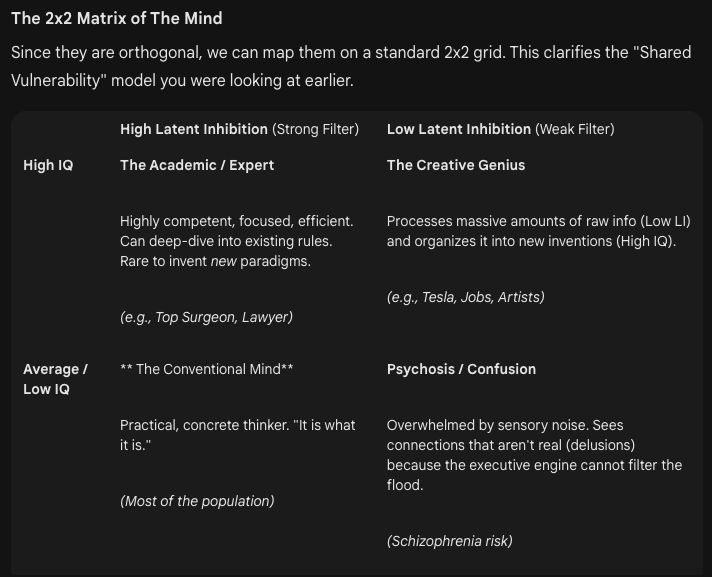
- The Danger (Low LI + Low/Avg IQ): If the floodgates are open but the engine is weak, the Prefrontal Cortex (PFC) gets overwhelmed. Bottom-up sensory noise drowns out top-down control, leading to confusion, anxiety, or psychosis.
- The Genius (Low LI + High IQ): The Dorsolateral Prefrontal Cortex (DLPFC) exerts strong executive control. Instead of being drowned by the extra information, the High IQ brain captures it. It takes the “noise” (that a normal brain ignores) and organizes it into novel patterns.
The Trade-Off:
- The Striatum/Dopamine: Supplies the Quantity of ideas (unfiltered data).
- The Cortex/IQ: Supplies the Quality control (logic and structure).
The Physics of Thought (Spreading Activation)
Deepening the understanding of how these connections are formed requires looking at Neural Inhibition and Spreading Activation.
The Mechanism: “Dampening” the Signal
Memories and concepts are stored in neural nodes. When you think of a concept (e.g., “Apple”), it fires an electrical signal that tries to spread to related nodes (Red → Fruit → Pie → Newton → Gravity).
- The Dampener: The neurotransmitter GABA (Gamma-Aminobutyric Acid) acts as the brake. Its job is to stop the electrical signal from spreading too far and activating irrelevant concepts.
- Stochastic Resonance: Research shows that a small amount of “neural noise” (random electrical activity) can actually boost creativity by pushing weak, remote ideas above the threshold of awareness.
The Inverted-U Model: Finding the Sweet Spot
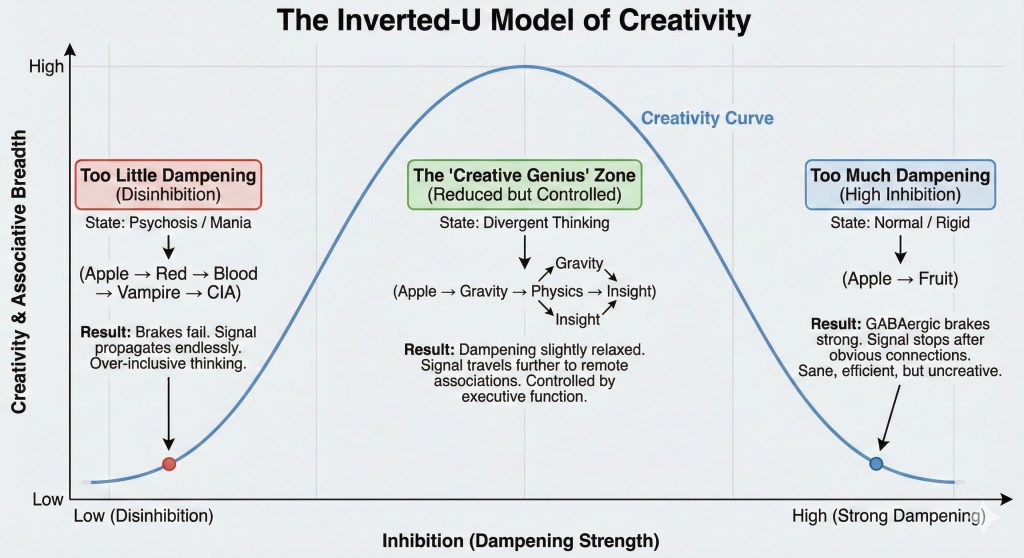
The relationship between inhibition (dampening) and creativity follows a curve.
- Too Much Dampening (High Inhibition):
- State: Normal / Rigid.
- Result: The GABAergic brakes are strong. The signal stops after the most obvious connections (Apple → Fruit). The thinking is sane and efficient, but uncreative.
- Too Little Dampening (Disinhibition):
- State: Psychosis / Mania.
- Result: The brakes fail. The signal propagates endlessly (Apple → Red → Blood → Vampire → CIA). The brain activates everything at once, unable to distinguish between insight and noise (Over-inclusive thinking).
- The “Creative Genius” Zone (Reduced but Controlled):
- State: Divergent Thinking.
- Result: The dampening is slightly relaxed. The signal travels further than average, reaching remote associations (Apple → Gravity), but is eventually stopped by executive control before it becomes nonsense.
Leading Theories and Research
This neurological framework is supported by several key psychological theories.
The Shared Vulnerability Model (Dr. Shelley Carson, Harvard)
This model argues that creative geniuses and people with psychosis share a biological trait: Cognitive Disinhibition (a weakened mental filter). The defining difference is IQ. High IQ provides the “cognitive reserve” or “ego strength” required to voluntarily edit and manage the widened associative network, whereas the psychotic individual is overwhelmed by it.
Eysenck’s Theory of Psychoticism
Hans Eysenck proposed that creativity is a form of “over-inclusive thinking.” He argued that the creative genius possesses the discipline to translate wild, disinhibited associations into a tangible, logical product.
References & Further Reading
- Primary Paper: “Decreased Latent Inhibition Is Associated With Increased Creative Achievement in High-Functioning Individuals”
- Video Lecture: Jordan Peterson on Creativity & IQ (YouTube)
- Related Concepts: Stochastic Resonance, P-FIT Network.


 Positive Tenacity
Leave a comment