Startup founders often wonder (and fear) when their growth will slow down and eventually plateau. Especially in the early days of achieving product-market fit, the hustle and rapid growth often lead founders to overlook certain crucial metrics that ultimately determine the growth limit of the company.
In biology and engineering, there is a concept called “Carrying Capacity” — which is usually a measure of a terminal value of some capacity, such as population growth, or the volume of water in a lake.

For example, in the graph above, assuming steady reproduction and influx of population along with a steady rate of death, the population of a city will initially grow slowly, then go through a period of rapid growth, eventually tapering off around the carrying capacity and reaching a stable equilibrium.
When the influx and outflux are relatively steady, the carrying capacity becomes a fixed number, asymptoting toward a terminal value. We only need to know two numbers to calculate the terminal value of a system: the absolute influx amount and the percentage of outflux over the same period of time.

Using this simple formula, we can easily calculate the Terminal ARR for your startup.
So, What is Terminal ARR?
Terminal ARR represents the equilibrium point of your annual recurring revenue, where the amount of new ARR added each year equals the ARR lost due to churn and downsell. It is the maximum revenue your startup is expected to stabilize at, given current growth strategies and customer retention. This metric is important for understanding when your business will reach a revenue plateau and for planning beyond that point.
Why It Matters
For startups, predicting long-term revenue is not just about impressing your management team or investors. It’s about survival and strategic planning. Knowing your Terminal ARR helps you:
- Set realistic growth targets: It calibrates your growth projections based on tangible input metrics.
- Manage cash flows better: By understanding when and how your revenue will stabilize, you can better manage spending and investments.
- Implement customer retention programs: Knowing how retention impacts long-term revenue can lead you to invest more proactively in customer success.
- Develop new growth strategies in advance: Understanding the underlying mechanics helps you prepare for the timing of new product launches, market expansions, and other growth strategies.
Calculating Terminal ARR: A Simple Formula
Let’s dive into how you can calculate this using just two numbers: your gross new ARR per year and your gross revenue retention rate. Using your gross revenue retention rate, you can calculate your churn & downsell %.

Using this number, you can calculate the Terminal ARR of your startup by applying the Carrying Capacity formula.

Definitions:
- Gross New ARR Per Year: This is the total new ARR that you expect to generate each year from new and upsells from your customers.
- Gross Revenue Retention Rate: This is the percentage of prior year’s revenue that you retain, after accounting for churn and downsell. For example, if you retain 90% of your revenue, your gross revenue retention rate is 0.90.
Example:
Imagine your startup is projecting to add $1,000,000 in new ARR each year, and your revenue retention rate is 90% (or 0.90).

This means that under current conditions, your business will eventually stabilize at an ARR of $10 million. However, if your retention falls to 80%, your Terminal ARR drops down to just $5 million.
This is why many investors focus on the revenue retention rate for startups (also known as the “leaky bucket problem”), as the sensitivity to revenue retention is quite high when it comes to calculating your Terminal ARR.
Strategic Implications
By understanding your Terminal ARR and the underlying input metrics (gross new ARR & gross revenue retention), you can set priorities to improve or structurally change the business.
To influence your Terminal ARR, you only need to change one of two metrics: gross new ARR or gross revenue retention. This helps you crystallize your priorities. Will you be fixing your influx of dollars or your outflux percentage?
By focusing on higher quality customers and deploying rigorous customer retention programs, you can gradually increase your revenue retention, but given that revenue retention is measured over a year-long period, it will take a good 12 months of lead time for your initiatives to impact the outcome. Having a long-term view and perseverance to push through your customer retention strategy is key.
Increasing your gross new ARR has more to do with your fundamental value proposition/product, marketing and sales strategies, and also overall funnel velocity (e.g., sales cycles), and unless you are selling to Fortune 100 or traditional enterprises, it is likely to be shorter than 12 months, so having a robust new and upsell revenue growth strategy can impact the Terminal ARR a bit faster.
But it’s crucial to continue paying attention to both input metrics to ensure you are maximizing the Terminal ARR of your startup. If you look at the matrix below, you can see how the combination of gross revenue retention and gross new ARR impacts the Terminal ARR of a company.
In the example table below, even with the same Gross New ARR, based on the retention, the Terminal ARR can have a 4x difference.
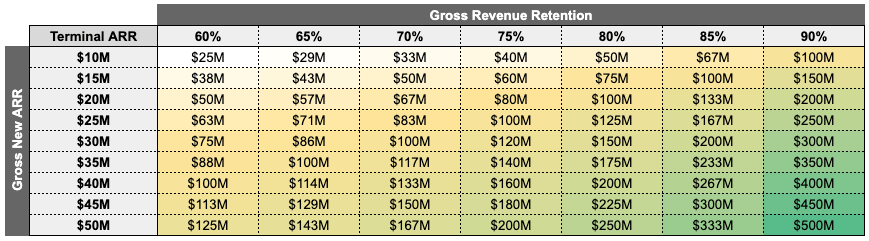
As you understand your own business and discover which metric is easier or harder to move, you will have to set your priorities and strategies — all of your product and go-to-market efforts will directly impact these numbers — and your growth potential.
Conclusion
For startup founders, understanding the long-term business potential is as crucial as product development, marketing, or sales. Calculating and understanding your Terminal ARR using this simple formula not only clarifies your long-term revenue potential but can also help you sharpen your strategic focus. Whether it’s adjusting your business model, product roadmap, customer targeting, customer success programs, or even planning for future funding, knowing your Terminal ARR can guide some of these critical decisions.
We need to remember that the goal of founders isn’t just to grow fast initially but to build a foundation for sustainable and long-term success.


 Positive Tenacity
Leave a comment